Butternut Squash Bisque with Crab, Corn & Fennel Salad (w/ wine pairings)

Butternut Squash Bisque with Crab & Corn Salad

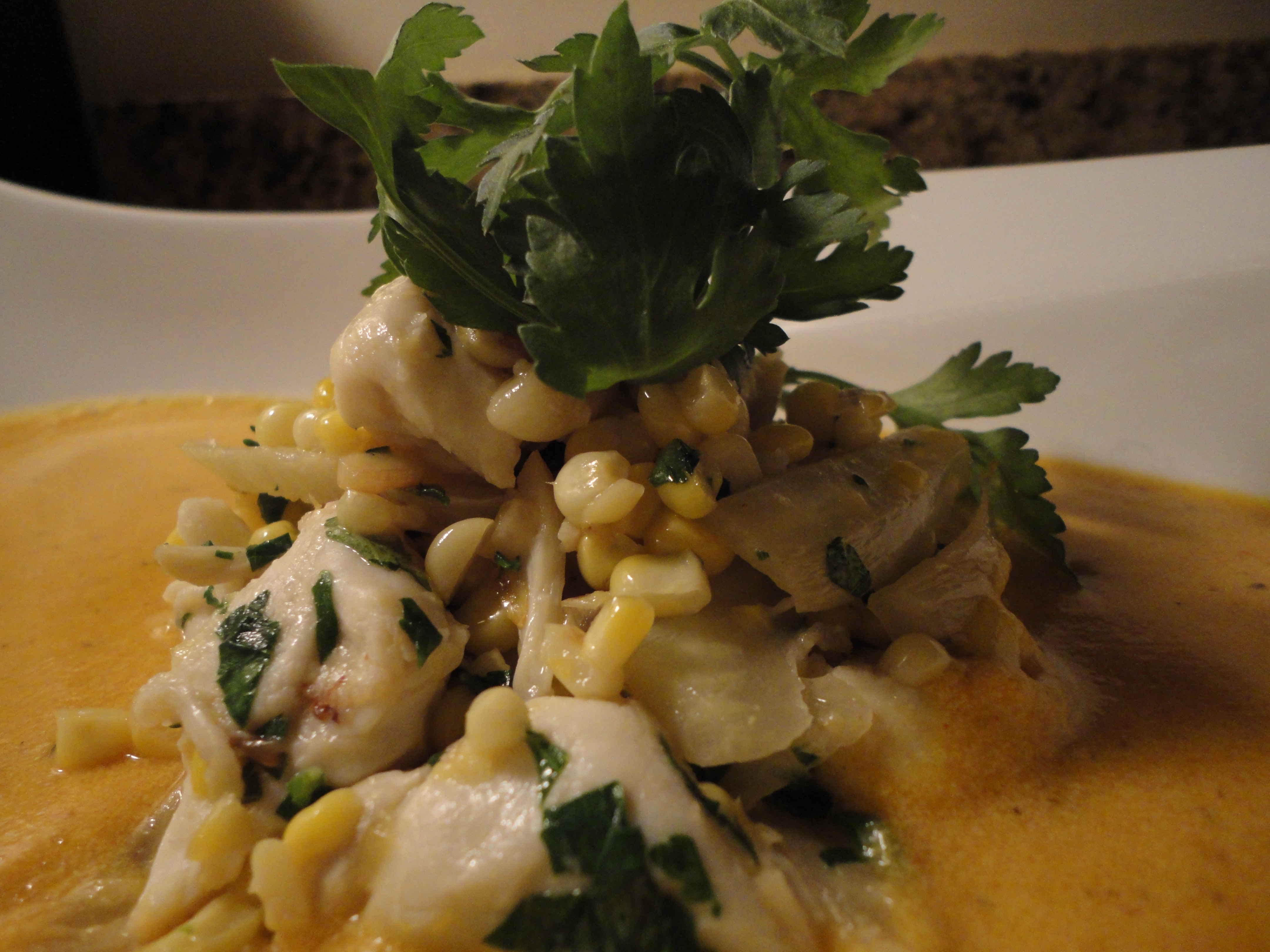
So I had some butternut squash laying around in the fridge the other day and my wife asked me to make some soup with it. Now before I go any further, let me explain something. My wife is a butternut squash bisque connoisseur… If we go to a restaurant and it’s on the menu, she orders it, every single time, and let’s just say we eat at some pretty damn good restaurants. What I’m getting at is that the competition here is stiff. I couldn’t just whip up a simple bisque and expect to wow her, I needed to take it to another level so I could even begin to compete with the soups she’s had. But what to do? I looked back in the fridge and noticed that I still had some really beautiful sweet corn on the cob and fennel bulb, and then it struck me… Butternut Squash Bisque with a Crab, Corn & Fennel Salad. Now THAT is taking it to the next level!

Serves 4 as an entrée or 6-8 as an appetizer.

Ingredients (bisque):
4c Butternut Squash, diced
2tbsp Olive Oil
1 1/2c Sweet White Wine
4c Chicken Stock
1c Heavy Cream
2tsp Salt
1tsp Ground Black Pepper
1tsp Paprika
1tsp Granulated Sugar
2tbsp Unsalted butter

Ingredients (crab salad):
1c Corn
1/2lb Jumbo Lump or Lump Crabmeat
2 Cloves Garlic, chopped
1/4c Shallot, chopped
1c Fennel Bulb, sliced
1/4c Fresh Parsley, chopped (+more for garnish)
1tsp Salt
1tsp Ground Black Pepper
2tbsp Unsalted Butter

In a large sauce pot heat the olive oil at medium high. Add the butternut squash and 1tsp of salt, sauté for 10 minutes to lightly brown the edges. Increase the heat to high and add the white wine, simmer until reduced by half. Add the chicken stock, bring to a boil then reduce heat to medium and simmer uncovered for 20 minutes, stirring periodically. Using a hand emulsifier, food processor, or blender, puree the butternut squash & stock mixture until blended smooth. Return it to the sauce pot and add the heavy cream, 1tsp salt, black pepper, paprika and sugar and stir together well. Simmer uncovered on medium low for an additional 20 minutes. Stir in the butter in the last few minutes to give the soup richer flavor and a silky sheen.

Once you have the bisque in its final simmer you can work on the crab salad, because it only takes about 10 minutes to make.

Melt the butter in a sauté pan at medium heat and add the garlic, shallot, fennel and salt. Sauté on medium until the vegetables start to sweat, 3-5 minutes. Add the corn and continue to sauté on medium heat for an additional 3 minutes. Remove from heat then toss in the crab and parsley. Keep at room temperature until ready to serve.

Before serving the soup check the seasoning to make sure it’s to your liking, add more salt or pepper as desired.

Spoon the crab salad into the center of your bowls then ladle the bisque around it, and finish it all off with a sprig of parsley for garnish.

There you have it, a delicious, decadent, over the top restaurant quality bisque that is easy to make and is most certainly going to impress your significant other, family and friends! I know it impressed my wife, and like I said up top, with this particular dish that is not easy to do…

Alright, now let’s talk wine pairings. There have been times in the past where I’ve paired a light bodied red, like Gamay, with butternut squash bisque… However, with the inclusion of the crab I would have to strongly recommend against it and say that you want to do a medium to full bodied white or a dry/off-dry sparkler. When I made this dish I paired it with a Blanc de Blancs Champagne, and it was perfect (no pun intended… ok, maybe a little). Below are a few wines I would recommend… Oh, and considering the fact that you’ve already spent the farm on lump crabmeat, don’t go cheap on the wine. You need to treat yourself once in a while.

Larmandier-Bernier Latitude Blanc de Blancs Extra Brut NV, Champagne, France – Both the Larmandier and Bernier families have been producing wines in Champagne since the late 18th century, but the they did not come together until a marriage joined them in 1971. Their Latitude cuvee is quite interesting in the fact that it is 100% Chardonnay, but the vineyards utilized are located in a region of the Côte des Blancs just below Vertus, where the primary varietal grown is Pinot Noir. The wine expresses a touch of berry fruit on the palate, exhibiting some undeniable Pinot-esque characteristics. In the glass is a medium bodied wine with pale straw color and moderate effervescence. The bouquet is extraordinarily aromatic, with hints of grapefruit pith, fennel frond, green apple and sourdough. On the pallet the wine is quite intense, with distinct impressions of crunchy minerality, salinity and a slight yeasty nature, all layered beautifully with nuances of apple, berry, clover honey and dried herbs. PP Score: 91 (Retail $48-55) *Certified Biodynamic

Trapet Gewurztraminer Beblenheim, Alsace, France – Domaine Trapet was established in 1870 in Gevrey-Chambertin, and over the past century plus have proven themselves to be one of the top producers in this prestigious appellation. In 1993 the newest Trapet generation took over, under the guidance of Jean-Louis Trapet, and he seamlessly continued on with the family’s impeccable  reputation. While Jean-Louis’s family had holdings in Burgundy, his wife’s family owns vineyards in Alsace and he decided it would be interesting to produce some wines from their vineyards as a fun little side project. So here we have the Gewurztraminer from their holdings in the Beblenheim Vineyard. I would rate the wine as a demi-sec (semi-dry), while there is residual sugar there is still a nice balancing acidity. On the palate you’ll find notes of lychee, mango and meyer lemon, with very subtle minerality in the mid-palate and finish. This one will likely be difficult to find with only 400 cases made per vintage, but it’s worth the search! PP Score: 91 (Retail $18-22) *Practicing Biodynamic

Domaine Huët Vouvray Demi-Sec Le Haut-Lieu , Loire, France Domaine Huët is the most storied name in Vouvray. The winery was founded by Victor Huët in 1928 and immediately established itself as the standard bearer of the appellation. While a number of producers in recent years have made a go at Huët’s title, no one has been able to wrest it from them. They are simply the best (cue Tina Turner). Their Demi-Sec from the Haut-Lieu vineyards is almost life changing, yeah, that good. The wine is medium to full bodied, with subtle notes of citrus zest, white peach, honeysuckle and crushed granite framed with a perfect harmony of citrus acidity and honeyed sweetness. Only 1,500 cases are made per vintage but despite this fact there is pretty strong distribution of the wine throughout the US and you should be able to get your hands on a bottle. Or, as I would recommend, buy every one you can find! Another beauty of this wine is that it can be laid down for another 15-20 years, and it should only get better! PP Score: 94 (Retail $34-40) *Certified Biodynamic

Peirson Meyer Chardonnay Charles Heintz Vineyard, Sonoma Coast, California – Peirson Meyer is the brain child of Alan Peirson and Robbie Meyer, two men who were instrumental in making Peter Michael what it is today. It is almost unfair to them to mention that, as they are extremely well regarded in their own right and they produce beautiful wines, but the value and allure of that pedigree cannot be denied and it’s something readers should be aware of. Their 2011 Charles Heintz Chardonnay is simply stunning. In the glass is a medium to full bodied wine of golden hue, think a summer sunset over Belgrade Lake in Maine. The bouquet is redolent with aromas of honeysuckle, citrus zest, dried herbs and hints of brioche. On the pallet the wine is rich, exhibiting notes similar to that of the bouquet, with moderate density balanced by subtle acidity and nuances of crushed rock, preventing the wine from becoming sappy. I will repeat, this wine is stunning. PP Score: 93 (Retail $54-62) *Only 400 cases produced

So there you have it, my recipe and some wines that I recommend to pair with it. I hope you enjoyed the read, will make the soup and try the wines. I guarantee you’ll love it, I know we did! As always new content is coming soon. In the meantime pop open a bottle of champagne, sit back, and relax. You don’t always need a special occasion for Champagne, sometimes the bottle itself IS the special occasion! Life is short, enjoy it.

Bon Appetit!

Homemade Pretzel Knots

Homemade Pretzel Knots

I started making homemade pretzels about a year ago and they’re a huge hit with my family and friends. Well, one of my coworkers saw the recipe a while back and has been harassing me to make them for the office ever since… but there’s a problem. My normal pretzel recipe makes 12 pretzels, there are 40 people in my company. I love my coworkers, but the last thing I feel like doing is spending an entire day making four batches of pretzels! Our first office meeting of the year is coming up, and I decided I was finally going to make them for everybody, but I desperately needed a smaller alternative. I made the dough, let it rise and turned it out onto the counter, still without having the first clue on how I was going to take a batch that makes 12 and turn it into 40… then it dawned on me.

Knots.

Genius! Everyone can have one and I don’t have to spent a full day making them.

So here is my recipe for Homemade Pretzel Knots. They are absolutely perfect for a party!

Makes 36-48 knots.

Ingredients:
4 1/2tsp Active Dry Yeast (2 envelopes)
1tsp Granulated Sugar (for yeast)
1 3/4c Warm Water (105-110F)

4 1/2c All Purpose Flour, plus more for kneading
1/2c Granulated Sugar (for dough)
2tsp Salt
2tbsp Unsalted Butter, melted (for dough)

1tbsp Olive Oil
1/2c Baking Soda
4tbsp Unsalted Butter, melted (for baking)
Toppings of preference

In a small bowl combine the yeast, 1tsp of sugar and warm water. Let stand until the water becomes creamy and you get a nice bloom on the top, approximately 15 minutes.

In a large mixing bowl combine your flour, 1/2c sugar and salt. Add the yeast mixture and start mixing on low speed. Once the dough begins to form slowly add 2tbsp of melted butter and increase the speed to medium. Continue mixing until the dough forms a ball around the dough hook.

Turn the dough out onto a lightly floured surface and knead for 5 to 7 minutes, it should have a smooth elastic texture. Lightly oil a large bowl with 1tbsp of olive oil, place the dough in the bowl and turn to coat entirely with the oil. Cover with plastic wrap and a towel and set in a warm, draft free, place until the dough doubles in size, approximately 1 hour to 1 hour 15 minutes. I typically set my oven to 350F and place the bowl with my dough on the stovetop to promote rising, the stove gets warm but not hot. This may work for some people, for others it may not, it depends on your oven/stove.

Heat your oven to 375F.

In a large sauce pot bring water to a simmer and add 1/2c of baking soda, allow to dissolve.

Turn out your risen dough onto a lightly floured surface. You don’t have to knead it again, just lightly punch it down with your fingers to remove some of the air. Using a knife divide the dough into however many knots you would like to make. Use your hands to roll each piece into a short rope (3-4″), then simply knot them. In small batches place the knots into the simmering water/baking soda and allow to cook for 10 seconds, then remove with a slotted spoon and place on greased baking sheets, leaving at least a half inch between them. Brush the top of the knots with melted butter and sprinkle with the seasonings of your choice. I made three different types: Sea Salt, Parmesan & Garlic, and Sriracha (A good friend gave us a Sriracha flake grinder… I never knew such a thing as Sriracha flakes existed!). Put whatever you want on them, go crazy! My wife even mentioned that they would have been delicious with some cinnamon and sugar… Hmmmm, that’s a thought.

Bake the knots in the oven for 11-14 minutes, until the tops are nicely browned.

Enjoy!

Greek Lamb Meatballs with Crispy Polenta (w/ wine pairings)

Greek Lamb Meatballs with Crispy Polenta

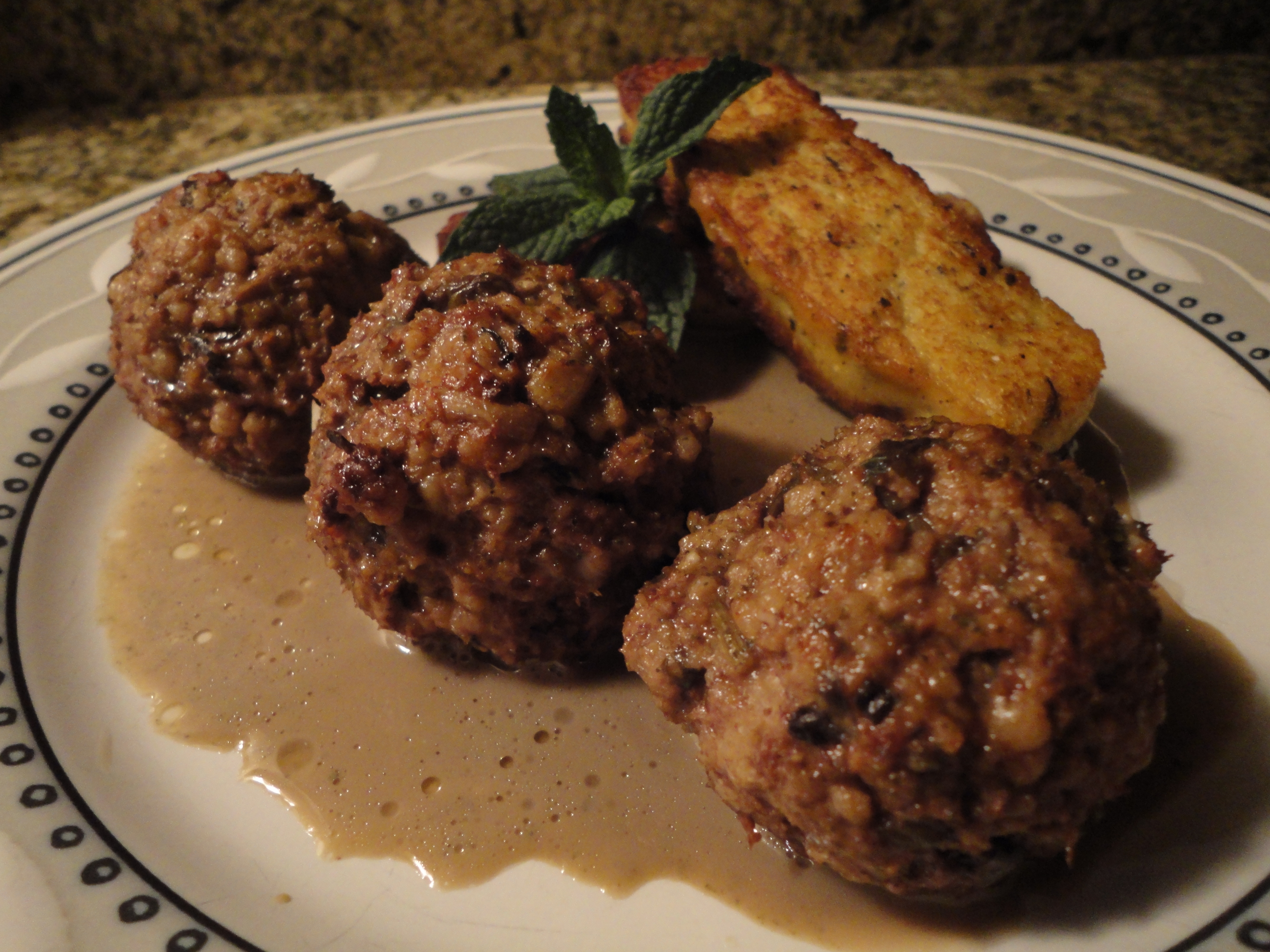
Recently it came to my attention that Chobani® Yogurt is running a #MadeWithChobani campaign, with food bloggers much like myself using Chobani’s products to come up with recipes. I looked over what others were posting and I immediately realized that almost no one was incorporating the yogurts into a savory dish. It was mainly parfaits, cheesecakes, shakes or adult beverages like piña coladas. So of course, with that being the case, I decided that I was going to challenge myself to make a savory entrée using their Greek yogurt… and being that it’s Greek yogurt, why not go Greek? Well, there’s nothing more Greek than lamb and mint, so I came up with a great recipe for Greek Lamb Meatballs, accompanied by crispy Parmesan & Herb Polenta, finished with a mint jus.

As a quick sidebar, before I get into the recipe portion of the show… I have to admit that I had never before had Chobani’s yogurts, and that frankly I’m not the biggest yogurt fan, Greek or otherwise. However, when I went to the store to pick up the plain yogurt for the recipe I decided to grab some of their other products to try out. It’s been a while since I’ve had yogurt so maybe my tastes have changed, or maybe Chobani is doing something better than what I’ve had in the past. So far I’ve tried their Oats with Apple & Cinnamon and their Flip with Clover Honey, and I was pleasantly surprised that I found them both to be delicious. I plan on trying some more of their yogurts, and I have a feeling that their products are going to become a staple in my family’s fridge. The timing is actually perfect being that I’m trying to drop a few pounds from some serious holiday gluttony, and at 100-200 calories they make for great meal replacements.

Alright, one more interruption before the recipe, last one I swear! If you’re not keen on the thought of polenta or a mint jus, these meatballs are also fantastic with tomato sauce. We had some leftover and I reheated them in sauce for our kids the next day, served over pasta, and it was fabulous. I just wanted to put that out there, I understand that not everyone is into things like “mint jus”.

Ok, onto the recipe!

Serves 4

Ingredients (meatballs):
2lb Ground Lamb
2tsp Salt
2tsp Ground Black Pepper
1tsp Crushed Red Pepper
1/2c Fresh Parsley, chopped
1/4c Mint, chopped
5 Cloves of Garlic, chopped
1c Panko, unseasoned
1c Ricotta Cheese
1/3c Grated Parmesan
2oz Chobani®Plain Greek Yogurt

Ingredients (polenta):
3c Chicken Stock
1c Yellow Corn Meal
2 Cloves of Garlic, chopped
1/2c Fresh Parsley, chopped
2tsp Salt
1tsp Ground Black Pepper
1/2c Grated Parmesan
3tbsp Olive Oil
3oz Chobani®Plain Greek Yogurt

Ingredients (mint jus):
1 1/2c Beef Stock, low sodium if available
1 Clove of Garlic, chopped
1c Mint, chopped
1tbsp Brown Sugar
2tbsp Unsalted Butter

Ok, so the first thing you’re going to want to do is make the polenta because you’ll need to chill it before getting it crispy…

In a medium sauce pot bring the chicken stock to a boil. Reduce the heat to medium and slowly add the corn meal, whisking continuously. If you add it all at once it’s just going to clump up and you’ll have a very difficult time making it smooth. Once all of the corn meal is incorporated and it’s whisking smoothly add the garlic, parsley, salt and black pepper. Reduce the heat to medium-low and simmer for 15 minutes, stirring periodically. Once done simmering turn off the heat and stir in the yogurt and parmesan. Pour the polenta into an oiled 9×5″ loaf pan and put in the freezer for 1 hour to chill. The reason for doing this is to firm it up enough to slice and sear.

Heat your oven to 375F.

In a large bowl combine all of the meatball ingredients. Using your hands roll the mixture into 2″ balls and place on a lightly greased baking sheet, you should get 16 meatballs. Bake for 30-35 minutes, the outsides should be lightly browned.

While the meatballs are baking it’s time to make the sauce and finish up the polenta.

In a small sauce pot combine the beef stock, garlic, mint and brown sugar. Bring to a boil then reduce the heat to medium and simmer until reduced by half. Once reduced, add the butter and then using a hand emulsifier, food processor or blender, blend the sauce. If you still have a fair amount of time before serving dinner simply keep it on heat over the lowest setting to keep warm, but it’s low enough to prevent further reduction.

Remove the polenta from the freezer. Invert the loaf pan over a cutting board to remove the polenta as a solid piece. If it does not come out when turned then gently separate along the edges using a knife or spatula. It should fall out when you turn it back over. Cut the polenta into 1″ wide slices along the long edge, you should get 8 slices. Heat the olive oil at medium-high in a large sauté pan. Place the slices of polenta in the pan, laying on their wider sides, and sear until browned, then flip and repeat.

And that’s everything… You have your meatballs, polenta and sauce. Plate it all up and απολαμβάνω (Google is telling me that’s “enjoy” in Greek, I’ll take their word for it… Feel free to correct me if it’s wrong. lol).

Now let’s talk wine pairings. You’re looking for a red, moderately full bodied, with slightly green notes to it. Think Greek Cabernets, Syrahs or Agiortiko. You could also hit a home run with a Chinon or Bourgueil from France, some cool little Alto Piemonte  or Valle d’Aoste wines from northwestern Italy, Aglianico from southern Italy, or even Malbecs and blends from the Salta region of Argentina. Here are a few suggestion, including what I had with dinner (listed first).

Estate Hatzimichalis Cabernet Sauvignon, Atalanti Valley, Greece – Atalani Valley is located in central Greece, bordered by mountain ranges to the north, west and south, and the Eubean Gulf to the east. Due to the combination of maritime influenced winds and cold mountaintop winds you’re left with a cool, dry region with a long growing season, which lends itself to elegantly developed and structured wines that have long ageability. The 2007 Cabernet from Hatzimichalis is just starting to come into it’s own. In the glass you’ll find a full bodied wine of dark purple hue. On the nose are aromas of ripe blackberry, fig, cassis, and balsamic, as well as subtle earth tones and dried tobacco. The palate reflects the bouquet, with additional nuances of fennel and oak, accompanied by firm tannins supplying a significant backbone, leading into a long and lingering finish. The wine is approachable now, but still has another 15 years of life in the bottle. I strongly recommend decanting for at least an hour, preferably longer, which is unusual for a wine in this price point… A beautiful wine and extraordinary value. PP Score: 91 (Retail $16-20)

Domaine du Bel Air Bourgueil “Jour de Soif”, Loire, France – This wine will forever hold a special place in my heart, as it’s the first Cabernet Franc that I ever truly enjoyed. Not to mention that its title, “Jour de Soif” translates to “drink the day”, which is essentially my favorite past time! Domaine du Bel Air is owned by the Gauthier family who have been producing wines from their 18 hectare estate for generations, but didn’t start bottling to sell until 1979. This is their entry cuvee, 100% Cabernet Franc from their youngest vines, approximately 20 years of age, aged in stainless steel to allow the fruit to shine and give it a refreshing brightness. On the palate you find notes of dark cherry, slightly tart raspberry, dried thyme and a hint of bell pepper. The wine is medium bodied but is a surprisingly light on it’s feet with a beautiful acidic lift and subtle chewy tannins adding depth and character. PP Score: 89 (Retail $13-16) *Certified Organic

Hermanos Malbec/Tannat Blend, Salta, Argentina – Hermanos is named accordingly as it is the project of three brothers who were raised in the winemaking world of Salta, a high elevation region in the Andes Mountains in Argentina. Their red blend is a mix of 70% Malbec and 30% Tannat, yielded from younger vines (average age of 16 years) located in vineyards with an average elevation of approximately 7,000 feet above sea level. The vineyards see about 340 days per year of unobscured sunlight, leading to rich concentration in the grapes, however, the cool high elevation temperatures lend balance and structure, rather than jammy lushness. In the glass is a full bodied wine with subtle notes of dark cherry, blackberry, bitter chocolate and licorise, and more pronounced notes of green garden vegetable, dried herbs, churned loam and hints of smoke, framed by subtle acidity and firm tannins. A very interesting wine, but not necessarily for everyone. PP Score: 88 (Retail $14-17)

There you have it, my Greek Lamb Meatball and Crispy Polenta recipe, as well as a few recommended wines. I hope you’d enjoyed the read and will try the recipe and wines (if you can find them). I also hope that you’ll give Chobani’s Greek yogurts a try, they really are delicious. As always new content in en route, in the meantime crack open a bottle of Greek wine and yell OPA! (but don’t throw your glass on the floor)… Life is short, enjoy it!

καλή όρεξη!

Vegan Winter Vegetable Barley Soup

Winter Vegetable Barley Soup

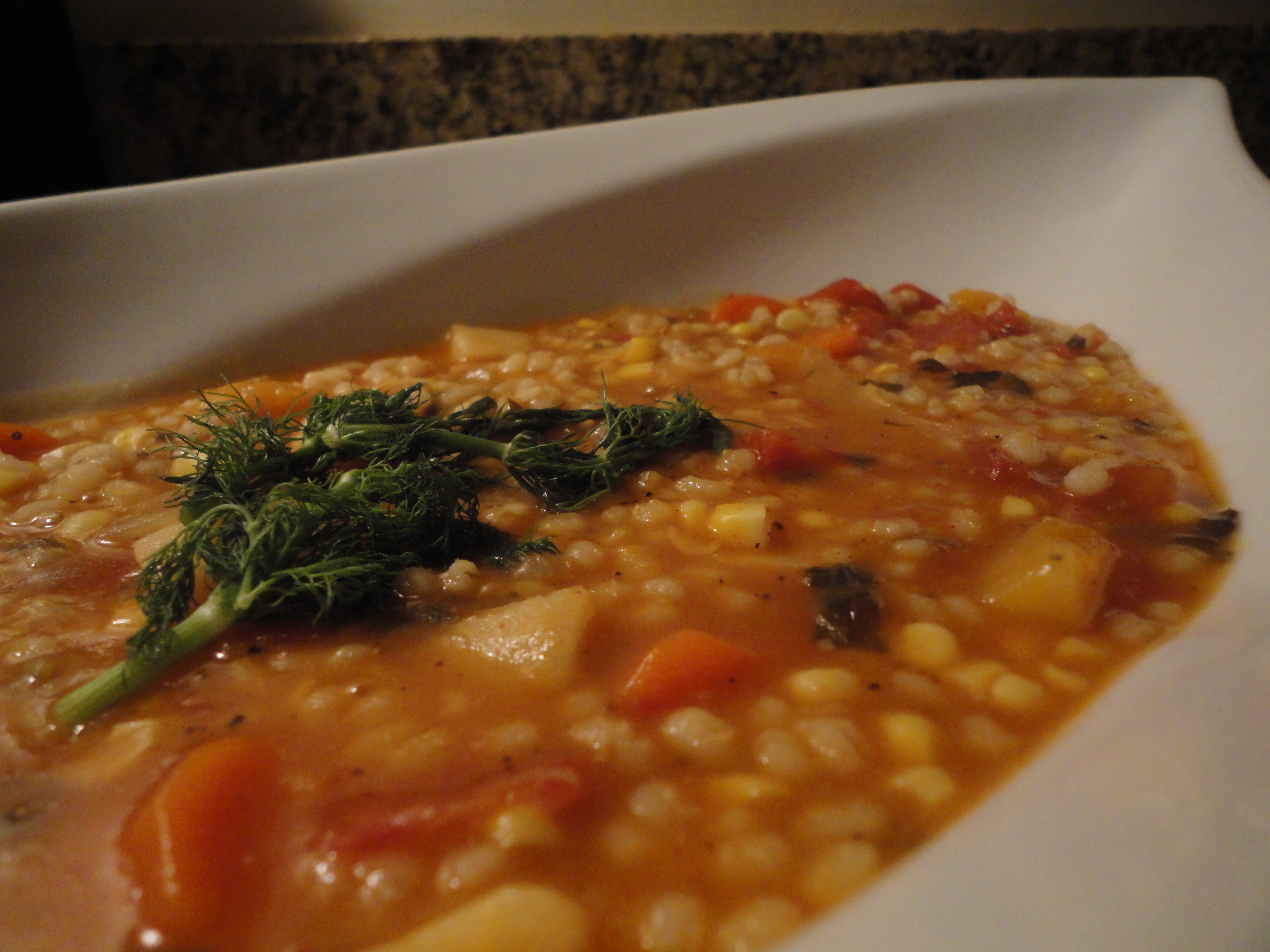
I knew I wanted soup for dinner yesterday, but I was torn on what to make… So, I opened the floor for our fantastic Facebook followers to put in some requests, and vegetable barley won out. Of course I couldn’t simply make a regular old vegetable barley soup (where’s the fun in that?), so I played with it a little and made a nice, hearty winter vegetable rendition of this classic comfort food. I hope you enjoy, and a big THANKS to those that shared their ideas on Facebook.

Serves 4-6 as an entrée, or 8-12 as an appetizer.

Ingredients:
3tbsp Olive Oil
4 Cloves of Garlic, chopped
1/4c Shallot, chopped
1c Fennel Bulb, sliced
3 Cobs of Corn, cut off the kernels but do not discard the cobs
2c Butternut Squash, diced
1 1/2c Parsnip, diced
1 1/2c Carrot, diced
2 Celery Stalks, sliced
2 Bay Leaves
1c Fresh Parsley, chopped
1c Barley

1c Dry White Wine
32oz Vegetable Stock
28oz Canned Diced Tomatoes
6c Water

4tsp Salt, (2) 2tsp portions
1tbsp Ground Black Pepper
2tsp Paprika

Heat the olive oil in a large pot (I use an 8qt sauce pot) on medium. Add the garlic, shallots, fennel, parsnip, carrot and celery, as well as 2tsp of salt, and cook for 10 minutes. Increase the heat to high and add the white wine, boil until reduced by half. Add the vegetable stock, water, corn cobs (NOT the kernels, yet) and bay leaves, bring to a boil then reduce the heat to medium low and simmer for 1 hour, stirring periodically. After 1 hour remove the corn cobs and bay leaves, then add the salt, pepper, paprika, diced tomato (with liquid), corn kernels, butternut squash, parsley and barley. Increase the heat to high and bring to a boil, then once again reduce your heat to medium low and simmer for an additional 45 minutes, stirring periodically.

That’s it, you’re done! You are now the proud owner of a healthy, filling, and intensely flavorful vegetable barley soup. If you want to get fancy use a little fennel frond for garnish and added anise flavoring.

Bon Appetit!