Homemade Pierogies (w/ wine pairings)

DSC03307

Everyone has that favorite dish that their Grandma used to make. For some people it’s a Sunday sauce, for others it could be lasagna, or stuffed cabbage, or apple pie… For me, from my mother’s side of the family, it had always been pierogies. My Grandma and Grandpa Petryshyn turned me into a veritable pierogi junky very early in life. If someone let me back in the day I would have hunkered down and eaten a dozen of them, at least! So for some reason I was a little nostalgic yesterday and found that I kept thinking about my adorable little Grandma who passed away a number of years back, and my Grandpa who lives half a country away, and it became resoundingly clear to me what I had to make for dinner, my favorite meal with them, pierogies. The thing is, I wanted to do something different. While I was absolutely obsessed with their delicious little chewy pockets of potato and sour cream goodness when I was a kid, I find that 20 years later I’m looking for something… else. Don’t get me wrong, I would happily eat their pierogies on a regular basis, but if I’m making them I want a twist, a play on flavors and textures… a little more balance.

So here is my own pierogi recipe, in homage my beloved Grandma and Grandpa Petryshyn.

Serves 4 (makes 24-28 pierogies)

One quick note… If you don’t want to make the dish the way I made it and are looking for something more traditional, then you’re still good to go with this recipe. Just don’t top the dish with the tomato, jalapeno, arugula, oil and lemon. What you’re left with would be a traditional pierogie dish with sautéed onions and garlic in butter. Just be aware that this pierogi dough is a little different than typical… it’s less doughy, has more crunch to it.

Ingredients (filling):
4 Potatoes, peeled
1/2tsp Salt
1/2tsp Garlic Powder
1tsp Ground Black Pepper
3oz Sour Cream
1c Shredded Cheddar

Ingredients (dough):
3c All Purpose Flour
3 Large Eggs
1/2c Water
1tbsp Olive Oil

Ingredients (everything else):
2tbsp Unsalted Butter
1tsp Salt
1tsp Ground Black Pepper
2 Jalapeno, chopped
4 Plum Tomato, diced
2 Spanish Onions, sliced
3 Cloves Garlic, chopped
2oz Fresh Baby Arugula
4tsp Extra Virgin Olive Oil
1 Lemon

Ok so the first thing we have to do is make the filling for the pierogies, because it needs to cool before you can put everything together. Boil your peeled potatoes, drain them and then whip them with the salt, pepper, garlic powder, sour cream and shredded cheddar cheese. Once fully blended put the bowl in the fridge and allow to cool, about 1-1.5 hours depending on your refrigerator’s temperature setting.

While the filling is cooling down it’s time to make the dough. Traditionally you would make it in a bowl by hand, but this is the 21st century people. God invented Kitchen Aids for a reason! Put your flour in a mixing bowl. In a separate bowl whisk together your eggs, water and 1tsp of olive oil. Add to the flour and mix, starting slow and moving up to a medium speed, as you’re mixing slowly add the remaining 2tsp of olive oil. Once mixed turn your dough out onto a floured surface and knead until smooth and elastic, approximately 8-10 minutes. You may need to use a little force while kneading… it’s not uncommon for me to punch it, literally. Wrap in plastic wrap and let rest at room temp for 30 minutes.

Alright… you’ve now let it rest 30 minutes, it’s amazing how time flies! If you’re lucky enough to have a pasta attachment for your Kitchen Aid, good for you, go ahead and use it. If you don’t, like me, get ready to use some muscle and do it old school. Turn the dough back out onto a lightly floured surface, cut it into quarters and start rolling it out. Your goal is a thickness of roughly 1/16 of an inch. Once you’ve achieved that use a ring mold to cut out circles and set aside, I used a 3.5″ mold. Take your surplus dough, knead back together and start over. You should be able to get approximately 24-28 pierogies from the batch.

So let’s stuff the pierogies. First, get a bowl of cold water and a fork. Take your dough circles, one at a time stretch them out a little, place a spoonful (I use a teaspoon, not the measuring kind, the stir your coffee kind) of the filling in the center. Wet the edges with water, stretch and fold over. Use the fork to crimp the edges. To get rid of any excess dough I use the ring mold to cut the edges down closer to the filled center. Set aside on an oiled plate (so it doesn’t stick to the plate, and they don’t stick to each other).

To cook the pierogies you’re likely going to have to get them started in two or three batches, depending on how big your largest sauté pan is, but you’re finishing in the oven so everything will be done at the same time.

Heat your oven to 400F.

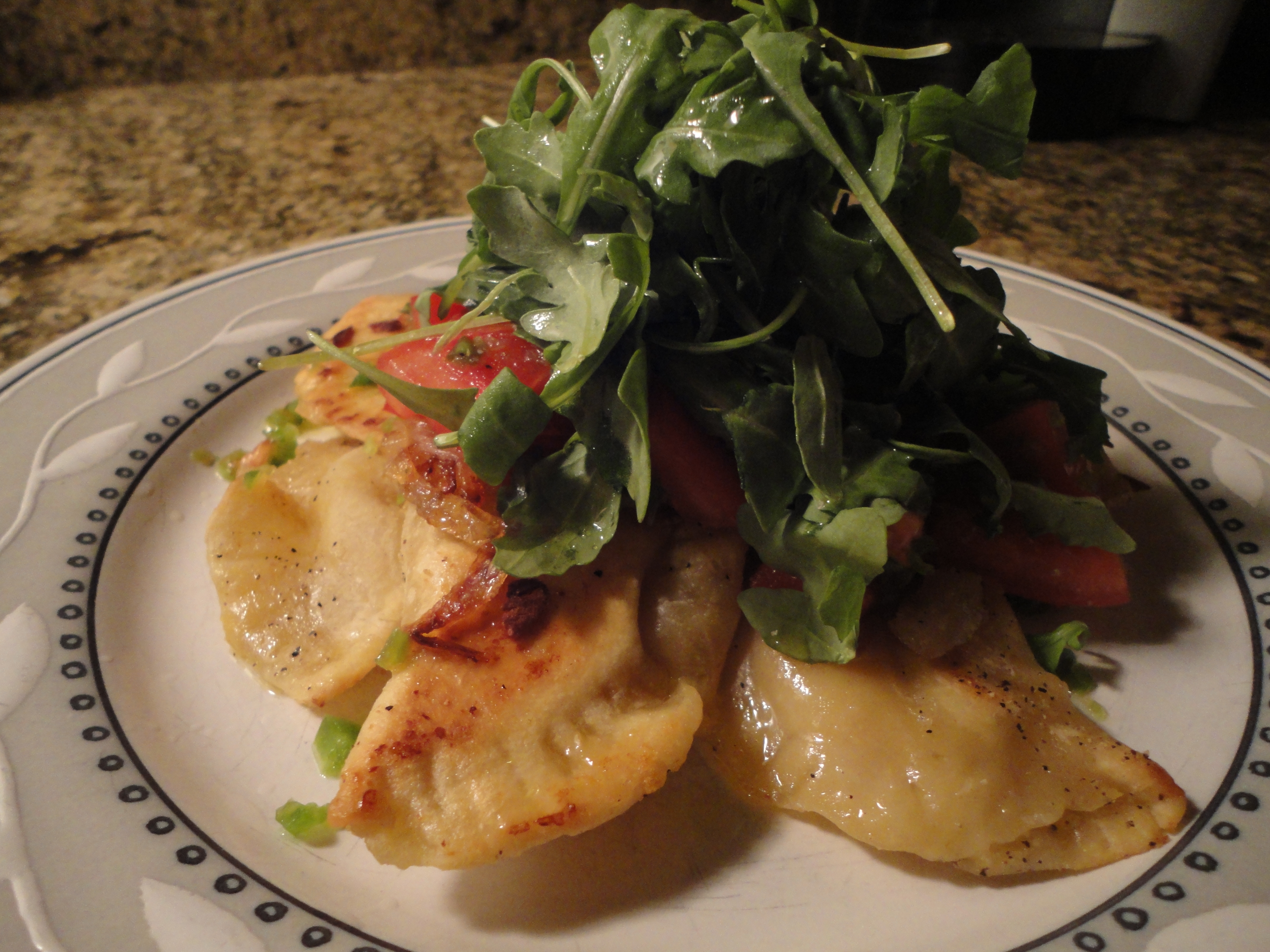
Heat a large sauté pan at medium-high heat and melt your butter. Add as many pierogies as you can without them being crammed too close together. Cook until lightly browned then flip and repeat. Remove from the pan and put in a 9.5×13 baking pan. You may need to add a little more butter in subsequent batches… Once all of the pierogies are cooked and in the baking pan, lightly cook your onion and garlic in the same sauté pan until they start to sweat, then layer them over the pierogies. Cook the pierogies in the oven for 10 minutes. Once done go ahead and plate them up, top them with the diced tomato and chopped jalapeno, then place the arugula on top of that. To finish the plates lightly drizzle them with extra virgin olive oil (about 1tsp for each plate) and fresh squeezed lemon juice.

Приємного апетиту! (Bon Appétit in Ukrainian)

Now let’s talk wine. I would recommend a medium-to-full bodied red in this scenario, especially something with moderate acidity to play with the tomato and lemon, as well as some garden green notes to work with the jalapeno. The first wine listed is what we had with dinner, and it was perfect.

Clos des Fous Cabernet Sauvignon, Cachapoal-Andes, Chile – This is Clos des Fous’ second appearance on the site, so I guess I kind of like them… The winery and vineyards were established a handful of years back by four Chilean visionaries, or as they term themselves, fools (fous): viticulturist Paco Leyton, winemaker Francois Massoc, terroir hunter Pedro Parra, and “bringer of wisdom” Albert Cussen. They, along with a handful of other new producers in Chile, have started a movement called “The New Chile” (which I will be writing on article on in the near future). The New Chile movement is the belief of making wines that are small production and terroir driven, the exact opposite of what Chile winemaking has always been, which was mass production and consistency of flavor. Clos des Fous Cabernet is like nothing I’ve ever tasted. The wine is medium bodied, aged entirely in stainless steel allowing the fruit to shine and giving it lift. On the palate are notes of cherry, dried herbs, jalapeno and crushed rock, with subtle acidic undertones and a sturdy dry tannic backbone. For Chile, this wine is surprisingly complex, and best yet, it lacks that “green” characteristic that you’re so used to in wines from this region. (Retail $18-23)

Chais St. Laurent Chinon, Loire, France – The Chais St. Laurent wines are made by Foucher-Lebrun, a “Petit Négociant” specializing in wines from the Loire Valley. While many times négociants are frowned upon in France (although readily accepted everywhere else in the world), no one dares to speak ill of Foucher-Lebrun. They have been producing wines since 1921, and over the last 90+ years have developed relationship with some of the top growers in the region, from whom they source their grapes from. The Cabernet Franc for their Chinon is sourced from the villages of Rivière, Beaumont-en-Véron and Savigny-en-Véron. The wine is extremely bright and friendly, aged entirely in stainless steel letting the fruit shine rather than fight for attention. On the palate you’ll find notes of bright cherry, tart raspberry, dried herbs and green bell pepper with subtle acidity and chewy tannins in the finish. They only make roughly 3,500 cases of the Chinon, so it’s not the easiest to find, but there are retailers online who you could purchase from if it’s not readily available in your area. (Retail $9-12)

Foxglove Cabernet Sauvignon, Paso Robles, California – Foxglove is a label of the famous Varner twins, Jim and Bob, who are also the owners of Varner and Neely whose wines are extremely small production and in high demand. They created Foxglove in 1991, when they realized that in addition to their two primary labels they also wanted to produce wines that were more affordable for the average consumer. Their Cabernet Sauvignon is like none other I’ve ever tasted from California. It’s dark and fruit driven on the entry, with lush notes of ripe red fruit and blackberries, but then it transitions into this funky mid-palate where you find nuances of garden green vegetables, fresh herbs, pantry spice and earth. Another thing that sets it apart is that it is aged primarily in stainless steel, allowing the fruit to take center state. This is a great Cab for those looking to expand their horizons! (Retail $13-16)

So that’s my pierogi recipe, with some crazy toppings, and my recommended pairings. I hope you enjoyed the read, and I hope you enjoy the recipe. New content will be coming soon, but in the meantime crack open a bottle of something funky, sit back, and relax. Life is short, enjoy it!

In loving memory of Martha Petryshyn…

Grandma and Grandpa

Spicy Seafood & Risotto Cake (w/ wine pairings)

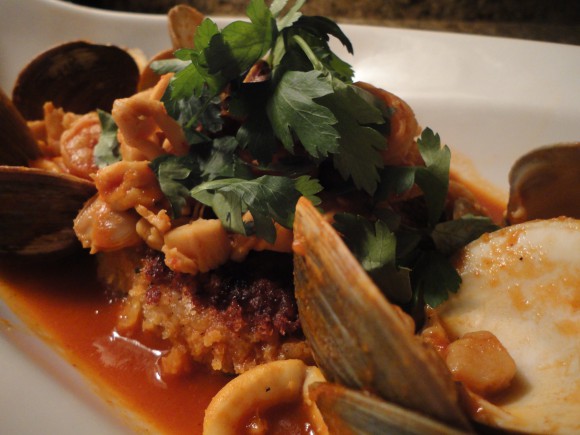
Risotto Crab Cake with Spicy Seafood Broth

So the other day I received a request for a crab cake recipe… the problem with that is there are thousands of them already on the internet. What could I do that would make it interesting? Well, one thing I cook moderately often are risotto cakes, so why not incorporate the crabmeat into that!? Sure, it’s been done before, but at least it’s a twist. Check out the recipe and pairings, and let me know what you think…

Serves 4

Ingredients (risotto cake):
2tbsp Unsalted Butter
1/2c Arborio Rice
2c Warmed Chicken Stock
2 Cloves Garlic, chopped
1/2 Red Bell Pepper, diced
1 Jalapeno, seeded and diced
1/3tsp Salt (for veg)
1/2tsp Ground Black Pepper
8oz Crabmeat
1c Panko, unseasoned
2tbsp Olive Oil

Ingredients (seafood broth):
14oz Canned Pureed Tomato
2c White Wine
1c Chicken Stock
1tbsp Unsalted Butter
3 Clove Garlic, chopped
1/2 Yellow Onion, chopped
1 Red Bell Pepper, diced
1/3tsp Salt (for veg)
1/2tsp Salt (for broth)
1/2tsp Ground Black Pepper
1tsp Crushed Red Pepper Flakes
1/2tsp Garlic Powder
1tsp Chili Powder
1tbsp Sriracha
1/2lb Shrimp, peeled and deveined
1/2lb Bay Scallopes
1/2lb Calamari, sliced into rings
2doz Little Neck Clams
Fresh Parsley for garnish

The risotto needs to be made in advance as it needs to be cold to mold into the cake.

In a sauce pot warm your 2 cups of chicken stock, bring to a simmer then reduce the heat to low.

In a medium sauce pot on medium-high heat melt your butter. Add the garlic, bell pepper, jalapeno and salt. Cook until the vegetables start to sweat then add your risotto and black pepper, cook for 2 minutes, stirring regularly. Reduce your heat to medium, add a half of a cup of warm chicken stock and stir regularly. Once the rice is almost dry, add another half of a cup. Continue to do this, stirring regularly until the rice is finished, approximately 30 minutes. The rice should still be slightly al dente, but have a creamy texture (not loose). Remove from heat and stir in the crabmeat. Cool in the refrigerator for at least one hour.

After the risotto has cooled, form into four equal balls. Put the panko in a bowl and one at a time put each risotto ball in the panko, coating evenly. Place on a flat surface and press the top down lightly to slightly flatten and form a cake shape. Put your cakes in the fridge to set.

In a large sauce pot melt your butter at medium-high heat. Add your garlic and red bell pepper, sprinkle with 1/3tsp of salt and cook until they start to sweat. Add the white wine, chicken stock and tomato puree. Increase your heat to high and bring to a boil for three minutes, stirring periodically, then reduce heat to medium-low and allow to simmer for 30 minutes, stirring periodically. After 30 minutes remove from the heat, then using a food processor, blender or hand emulsifier, liquefy the sauce. Put the sauce back in the pot, add your fresh clams and seasoning, cover and simmer at low heat, stirring periodically.

Heat your oven to 375F.

Take your set risotto cakes from the fridge. In a large sauté pan heat the olive oil at medium-high. Place the crab cakes in the hot oil and sear until the bottom is lightly browned, flip and repeat. Once both sides are browned put your crab cakes in the oven and cook an additional 10 minutes.

Once you’ve put the crab cakes in the oven, add the shrimp, scallops and calamari to the sauce, continue to simmer uncovered on low, stirring periodically. After 10 minutes the seafood broth and the crab cakes should both be done.

To plate, use a ladle to put a pool of broth in the bottom of your bowls. Set your crab cake in the broth and top with the shrimp, scallops and calamari, place your clams alongside, then top with fresh parsley. That’s it, your done… time to eat!

So let’s talk wine pairings. I personally prefer to pair a white, specifically something with salinity, citrus and a bit of body… think aged Muscadet, 1’er Cru Chablis, Bordeaux blancs from Entres-Deux-Mers, fuller bodied Albarinos, coastal Chilean Sauvignon Blancs, California Sauvignon Blancs with some barrel aging… you get the picture. So below are my three picks, including what I drank that night.

Château Sainte Marie Entre-Deux-Mers Vieilles Vignes, Bordeaux, France – Sainte Marie was established by Gilles Dupuch in 1956, but it was always a hobby for the family as Gilles’ primary vocation was his insurance brokerage. However, in 1997 Gilles’ son Stephane took over and was able to focus all of his time, energy and passion on making the family wine, transforming the vineyards and drastically improving the final product. Their blanc is a blend of predominantly Sauvignon Blanc, as well as a fair amount of a Semillon and a small dose of Muscadelle. The Sauvignon gives the wine it’s crisp acidic characteristics as well as hints of salinity, the Semillon gives the wine depth and mouthfeel, while the Muscadelle supplies softer florals and complexity. On the palate up front you’ll find very pronounced citrus notes and subtle salinity, as well as razor sharp acidity. Mid palate is where you’ll start to find the full roundness of the Semillon that leads you to a moderately soft finish with subdued minerality and delicate nuances of white peach and crushed flowers. With over 8,300 cases made on an average vintage the wine should be readily available in most major markets. (Retail $13-17)

La Val Albarino, Rias Baixas, Spain – Bodegas La Val was one of the first wineries established in Rias Baixas back in the mid-80’s, and in my humble opinion they’ve been the standard bearer of the appellation since inception. Their 150 acres of vineyard are located in the Condado do Tea sub-region of the D.O. While most wineries in the region are planted on flat plains with full days of direct sunlight, La Val’s vineyards are located in a series of shallow valleys, giving some relief from both hot summer temperatures as well as continuous sunlight. The end result is a much more balanced and complex wine. So many Albarinos from the region are very floral, light and even sometimes moderately sweet… or as I think of them, uninteresting. La Val, however, is denser on the palate and while it still has some of the tell-tale Albarino floral characteristics, you’ll also find notes of citrus zest and crushed rock. Hands down, this is the best Albarino I’ve ever had from Rias Baixas. (Retail $12-15)

Sean Minor Four Bears Sauvignon Blanc, California – I’ve written about Sean Minor before, and trust me this is a name you’ll see repeatedly on this website. Not only do I love Sean’s wines, finding them to be some of the best values out of California, I also genuinely like him as a person. Both he and his lovely wife Nicole have one goal, and that is to create wines that go well beyond over delivering for the price. His Sauvignon Blanc is blended from parcels in Dry Creek, Lake County and the Central Coast. It is aged primarily in stainless, but to add a twist a small portion of the wine is aged on lees in neutral French barrel with periodic batonage, giving the wine great texture and a round mouthfeel. Up front you’ll find notes of lemon and grapefruit zest, along with moderate acidity, leading into a relatively full bodied mid palate and finish with hints of kiwi, slate and smoke. Sean flew under the radar for the first few years, but at this point he can be found in every US market, so you’ll have no difficulty getting your hands on this wine… Unless the store is sold out, which isn’t an uncommon occurrence! (Retail $12-15)

So there’s a crab cake recipe, as requested, and the wines I think would pair well. I hope you enjoyed the read, and more importantly I hope you make the dish and drink the wines! More content coming soon, but in the meantime crack open a bottle of something crisp and clean to celebrate the arrival of Spring, sit back, and relax. Life is short, enjoy it!

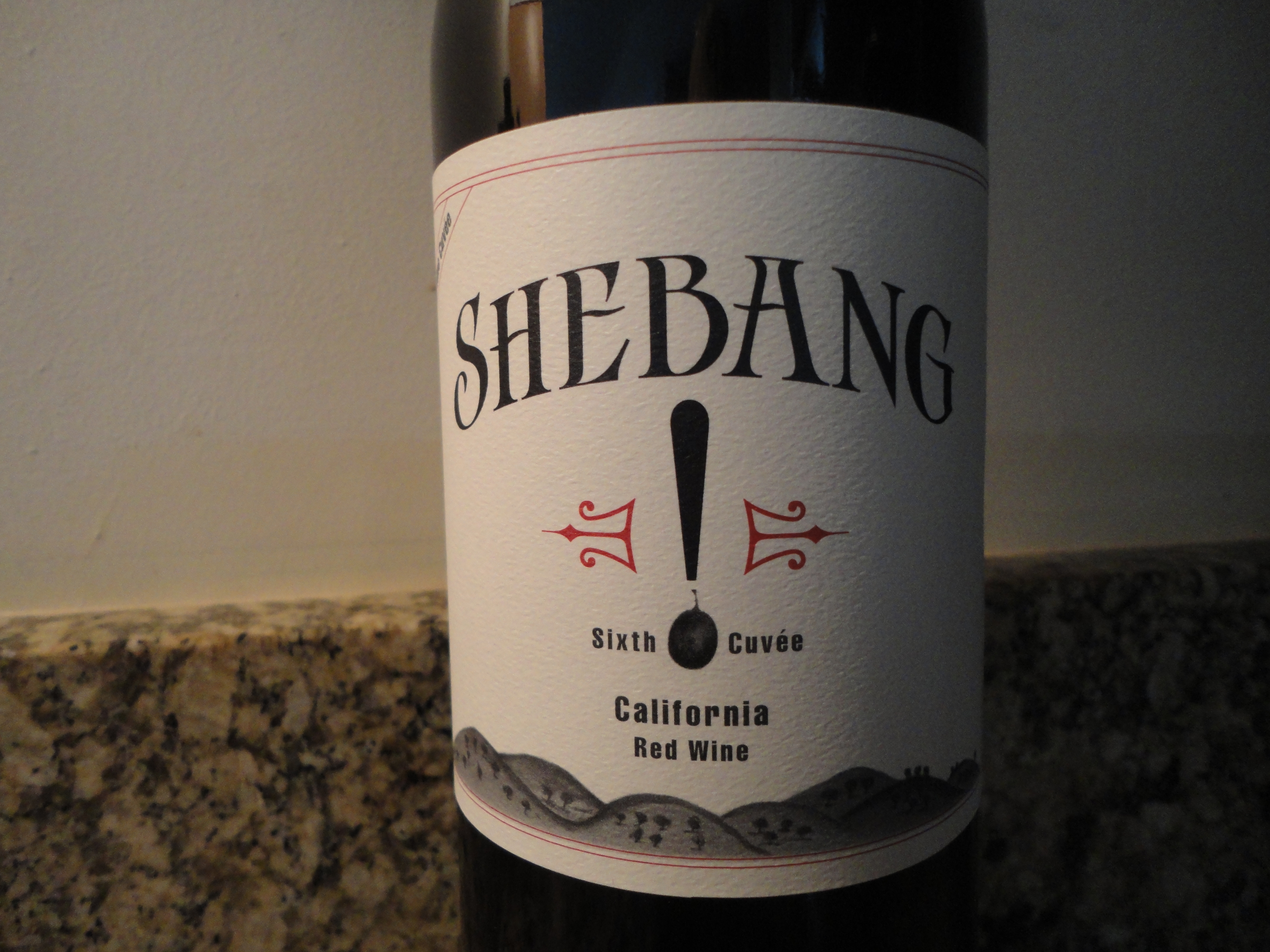
Wine Review – Shebang! by Bedrock Wine Company

DSC03295

Yes, you are reading that correctly… I am writing about a wine named Shebang! No, this is not Ricky Martin “shebang shebang”, instead this is a funky little non-vintage field blend made by one of the best names in the game, Morgan Twain-Peterson of Bedrock Wine Company, or as I affectionately refer to him, The Golden Child of California. Why would I call him that? Simple, because every wine he touches turns to gold. I’ve gone on record in my first ever article “California Wine Trends… Old is New” that Morgan’s 2009 Bedrock Wine Co. Stellwagon Zinfandel will forever be one of the most influential bottles I’ve ever tasted, as it is what sparked my passion for old vine California wines.

Morgan is the son of Joel Peterson, of Ravenswood fame, so you could say that great wine is in his DNA. His first vintage was 2007, making tiny quantities of wines out of an old chicken coop smaller than most Manhattan apartments (I’m not kidding). Bedrock Wine Company flew under the radar for a number of years, which made those “in the know” extremely happy, because there was less competition for the wine. Unfortunately (well, not unfortunately for Morgan) that is no longer the case and Bedrock wines are blowing up all over the world. He is pulling in some monster scores from critics like Bob Parker and Antonio Galloni, his Bedrock Heritage Red was #14 on Spectator’s Top 100 of 2013, and his Evangelho Red was included in John Bonne’s Top 100 of 2013… So yeah, he’s no longer under the radar, he’s blipping all over that thing!

Morgan’s passion is old vines… It is his mission to save old vineyards that are neglected or on the verge of being ripped up, and showing the world what unbelievable wines from California are really about. Sometimes I wonder if the guy even takes a paycheck because it seems like he uses the proceeds from each vintage to save a different vineyard.

So what’s any of this have to do with Shebang? Well, Shebang is a fun little project of Morgan’s where he can actually have some larger scale production. His Bedrock wines are amazing, but his case production ranges anywhere from 60-800 depending on the wine, and they sell anywhere from $22-75 per bottle on the shelf. Morgan wanted to create a label that could be more affordable for daily consumption, and steadily available in the market. The best way for him to accomplish this, while still maintaining the level of quality that we’re all used to from his wines, and still utilizing old vines, was to create a non-vintage blend using the juice that didn’t quite make the cut for his Bedrock Wine Co. wines, as well as sourcing from close friends of his. Each cuvee varies in terms of varietals and percentages, mainly because what is left over after each vintage will vary as different varietals or different vineyards put out stunning juice, or just pretty darn good juice. To the best of my knowledge, the current cuvee (his sixth) is predominantly old vine Zinfandel, with a supporting cast of Carignan, Alicante Bouchet, Syrah and God only knows what else. I bet if you asked him he wouldn’t even be entirely sure, some of his field blends over the years have had 30+ varietals!

Ok, that’s all fine, but what’s it taste like? Well, first and foremost the wine is medium-to-full bodied with a dark ruby hue. On the palate you’ll find notes of dark cherry, bramble fruit, black pepper, and subtle oak framed by mild acidity and silky soft tannins, leading to a moderate finish. This is a lot of juice in the bottle for the price… In fact Antonio Galloni has even gone on the record saying that “If there is a better value in California wine, I would like to know about. This is a ridiculously delicious wine for $12 a bottle.” Coming from Galloni, that speaks volumes.

As far as food pairings go, you don’t have to go too crazy on this one. Morgan makes this in a relatively straight forward style, and I find that it goes best with simple fair. Burgers, pizza, BBQ… those are all perfect pairings. Or just drink it by itself!

Now, let’s talk scores. Cuvee to cuvee this wine always gets between an 87-90, which are damn good scores for a wine in this price range. Myself, I am leaning towards the top of that spectrum, and I’m giving the Sixth Cuvee a firm 90. In my opinion wines in this price point very rarely warrant anything higher than that, so for me to say 90 I might as well be saying 99. To me, this is one of the top wines coming out of California at an every day price.

Retail $12-15

Pizza Mac ‘n Cheese (w/ wine pairings)

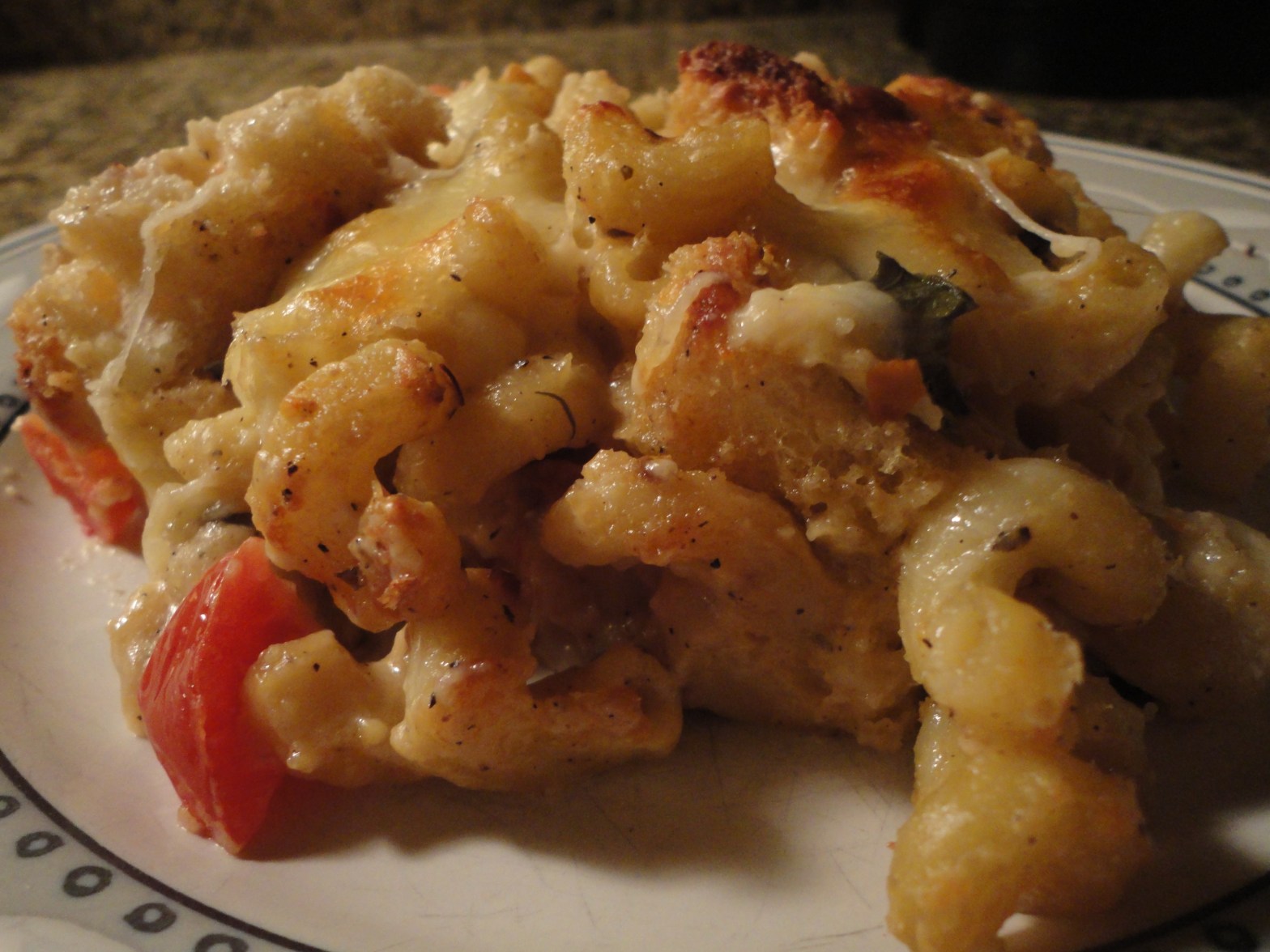
DSC03289

Over the past couple of weeks I’ve received a number of requests for a new mac ‘n cheese recipe, something different. I had to think on this for a while, I mean c’mon, it’s mac ‘n cheese… what hasn’t already been done? This dish has been an American staple at dinner tables for the last 70 years! I kept my ideas on the shelf while I worked on other projects, but every now and again I pulled them back down, dusted them off and tried to figure out what I could do that would be unique, but still delicious. One thought that kept creeping back into my head was pizza, and more specifically, margherita pizza… but there’s nothing special about that, right? Nearly everybody has some sort of a pizza mac recipe. That’s when it hit me. Everybody has a pizza mac recipe, but it’s just mac ‘n cheese with pizza toppings mixed in. Where’s the crust!?

AH HA!

So, at long last, here is my own original Margherita Pizza Mac ‘n Cheese recipe, along with wine pairings. Enjoy!

Serves: 4-6

Ingredients (béchamel):
6tbsp Unsalted Butter
1/3c All Purpose Flour
1c Heavy Cream
2c Whole Milk
1tsp Salt
1tsp Ground Black Pepper

Ingredients (croutons):
1 Loaf of Italian Bread, cut off the crust and cube approximately 1″x1″
4tbsp Unsalted Butter, melted
1/2tsp Salt
1tsp Ground Black Pepper
1tsp Garlic Powder

Ingredients (everything else):
1lb Pasta (I used Spirals No.38)
2c Fresh Diced Plum Tomato
1c Fresh Chopped Basil
1tsp Salt
1tsp Ground Black Pepper
1tsp Dried Oregano
1tsp Garlic Powder
1c Shredded Mozzarella Cheese
1c Grated Parmesan Cheese
1c Whole Milk Mozzarella, cubed

Heat oven to 350F

Ok, so first thing is to get started on the béchamel. One quick note, I strongly recommend using a non-stick pot for this, as the roux could stick to the bottom of a stainless pot and burn. Melt your butter at medium-high heat in a medium sauce pot and add your flour. Cook for two minutes, stirring continuously. The roux should be a light caramel color. Add the heavy cream, whole milk, salt and pepper. Increase the heat to high and bring to a boil, stirring continuously to fully blend the ingredients. Boil for three minutes, then reduce the heat to medium-low and simmer for ten minutes, stirring periodically. Remove from heat and set aside at room temperature.

Boil your pasta in salted water, cooking for one minute less than the instructions recommend.

In a large bowl combine your drained pasta, béchamel, diced plum tomato, chopped basil, shredded mozzarella, grated parmesan, salt, pepper, garlic powder and dried oregano. Stir until well integrated then pour into a baking pan (I used a medium sized aluminum lasagna pan because my 9×13’s were too shallow). Set aside and allow to rest for a bit before putting in the oven.

In a separate bowl toss your cubed bread with the salt, pepper, garlic powder and melted butter until evenly coated. Place on a baking sheet and bake in the oven for 30 minutes.

At the same time you put your seasoned croutons on the oven, cover the mac ‘n cheese with foil and place in the oven, also for 30 minutes.

After 30 minutes remove the croutons and mac ‘n cheese from the oven. Add the croutons to the mac and stir everything together. Evenly spread the cubed mozzarella over the mac, there will be gaps, the cheese isn’t mean to cover the top entirely. Increase the oven temperature to 400F. Bake the mac ‘n cheese uncovered for an additional 20 minutes, the top should begin to slightly brown. Remove from the oven and allow to rest for five minutes before serving.

Enjoy!

So let’s talk wine pairings. In my opinion it’s obvious that you need to go Italian here, I mean we’re talking about margherita pizza mac ‘n cheese for crying out loud! You definitely don’t need to go with anything too complex or expensive… It’s a simple straightforward dish, which calls for simple straightforward wines.

Locations Italy by Dave Phinney, Italy – Dave Phinney is the owner and winemaker of one of California’s truly iconic wineries, Orin Swift Cellars. In recent years Dave has broadened his horizons outside of California, making wines like Shatter (in collaboration with Joel Gott) and D66 from the Roussillon, and now his Locations label. The idea behind Locations was to create wines that are not constrained by appellation. Instead, Dave sources fruit from some of the top vineyards in different regions of that country to produce a truly extraordinary wine. In this first rendition of Locations Italy the blend is Primitivo, Negro Amaro, Nero d’Avola and Barbera taken from top vineyards in Sicily, Puglia and Piemonte. On the palate the wine is moderately straightforward, with notes of dark cherry, raspberry, dried basil, subtle oak and pantry spice balanced by subtle acidity and silky tannins. This is truly a beautiful and unique blend, the likes of which I’ve never seen before. Case production of this wine is pretty substantial and it can be found in most markets… Unfortunately NOT in my home state of New Jersey though, so I need to grab some whenever I head into New York. (Retail $16-20)

Tratturi Primitivo di Salento, Puglia, Italy – Primitivo is said to be the grandfather of Zinfandel. As a varietal it tends to be relatively bright and no-nonsense, and that is certainly the case with Tratturi. The wine is medium bodied with a very friendly fruit forward opening, and a slightly spicy mid palate and finish. There is not much to be said about Tratturi, and I don’t mean that in a bad way. This is one of those wines that you don’t feel the need to sit around and analyze, you just drink it, and usually lots of it! It is the ideal pizza and pasta wine, which makes it even more ideal when you’re combining pizza and pasta together! One thing to note, at this time this wine is only available in New York and New Jersey, so for those outside you’ll have to order online. There are a number of online retailers currently selling the wine, so it’s not going to be a hunt. (Retail $8-11)

Podere la Berta Sangiovese di Romagna, Emilia-Romagna, Italy – This is the second appearance this wine is making on the site, which should say something. The La Berta estate was recently purchased by the Poggiali family of Felsina and Castello di Farnetella fame in Tuscany. The family’s roots originate in Romagna, and they’ve always wanted to have a winery there, but they specifically wanted to focus on Sangiovese, which is not the predominant red varietal of the region. But when La Berta was put up for sale, a winery that specialized in Sangiovese di Romagna as well as the white varietal Albana, it was a no brainer for the Poggialis. The wine is really an absolute steal at the price point. There are distinct notes of cherry, ripe raspberry and fennel, with very subtle tannins giving the wine a touch of backbone. It is aged entirely in stainless with allows the fruit to really shine and gives the wine a wonderful brightness. This wine is one of the few Sangiovese that can be drank without needing food, but it makes for a great food wine as well. (Retail $12-15)

So that’s it folks, that’s my show. You asked for a unique mac ‘n cheese, hopefully I delivered what you were asking for! New content will be coming up soon. In the meantime, crack open a friendly little Italian red, sit back, and relax. Life is short, enjoy it!